
Have you ever wondered why it’s so hard to make a habit of that new exercise regime, or to practice consistently when you’re learning guitar, piano, Spanish, Chinese, or a myriad of other skills?
If you rely on willpower, you’re probably going to fail. It’s all too easy to slump onto the couch after you get home from a long day of work or school. And far too easy to fill up every minute of free time browsing social media, watching reality TV or gaming.
The trick to success is to form a habit around your new regime or practice as quickly as possible before you run out of willpower and enthusiasm.
But doesn’t it take a long time to form a new habit?
Well, that’s what I used to think.
Most people use a rule of thumb that it takes anywhere from 21 to 30 days to form a new habit, although there hasn’t been much data to back this up. The 21 days seems to have come from Maxwell Maltz’s book “Pyscho-cybernetics”.
Now, the latest research from the Health Behaviour Research Centre at University College London (UCL) shows that it’s more like 66 days for most folks – and that’s just the average. For some it can take as long as 254 days to form a habit!
Doesn’t sound too promising does it?
Well, what if I told you there’s a way to trick your brain into forming a rock solid habit much quicker than that?
I’m not talking months, or even weeks, but one week or less. That’s firmly in Habit Ninja territory in my book.
The method I use is based primarily on the idea of “Tiny Habits” developed by Dr B.J. Fogg at Stanford University, combined with a seemingly unrelated technique used by Scott Adams, that I call “Dilbert journalling”. You can read more about Scott’s journalling technique in the book “Mind Hacking” by Sir John Hargrave. I posted details about testing out this method in a longer habit ninja article here.
The Habit Ninja Method:
Preparation:
- The Tiny Behavior: Decide on the tiniest step you can take towards your new habit. In this example, I’m learning to play the guitar, so the tiniest step for me is to pick up the guitar and play one chord. That’s it! On those days where I’m just not feeling it, I can still feel good about myself if I just pick up the guitar and play that one chord. The vast majority of the time though, once I start, I’ve done the hard part, and I’ll end up practicing for 10, 20, 30 minutes or more.
- The Trigger: Decide where in your existing schedule you want the new tiny habit to fit in, and what behavior happens immediately before that time. For example, I want to practice guitar in the evenings after I finish eating dinner, but before cleaning the dishes (otherwise the dishwater will make my fingers soft and slow the formation of calluses).
- Formulate a Habit Statement: Write out a statement for your new habit using this format:
“after I <perform the trigger>, then I will <perform the tiny behavior>.”
My statement will look like this:
“after I finish eating dinner in the evening, I will pick up my guitar and play at least one chord.”
- Decide on the Reward for each successful completion of your Habit. The reward needs to be something you give yourself immediately after completing your new habit. Make sure you don’t wait, otherwise you aren’t training yourself for success. The reward doesn’t have to be anything major. It can be as simple as a pat on the back, punching the air and saying “Hell yeah!”, or “Well done old chap!” if you’re a Brit like me. Telling yourself you’ll grab a beer or ice cream later doesn’t cut it because the reward won’t be tied to the new behavior.
- Prepare your environment in advance. I recommend doing set up the night before. Make sure all equipment and environmental spaces are set up and ready for you to perform your new habit. If you’re going to the gym first thing in the morning, make sure to pack your gym bag the night before. For my example, I make sure the guitar is in plain sight close to the dining table, and my tab sheets are close to hand.
Installing the Habit:
For the next week you will do these three things each day:
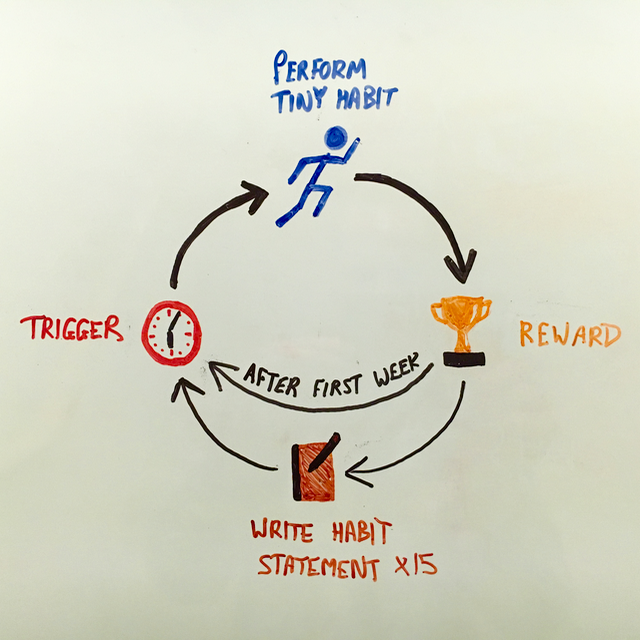
- Perform the Tiny Behavior after the Trigger, as defined in your Habit Statement above.
- Reward yourself immediately after completing it.
- Write out your new Habit Statement 15 times by hand at bedtime. Yes, using a pen. In a notebook. This is the “Dilbert Journal” technique. Do this before bed each day for 1 week.
In one week, your new habit statement will be embedded in your brain, and your new habit will be well and truly a thing of, well, habit!
After the first week you can continue steps 1 and 2, but feel free to drop step 3, you won’t need it any more.
Give it a try and let me how it works for you in the comments section below.
Troubleshooting
- Struggling with hard to kick “bad habits?” STOP! This isn’t intended as a replacement for a formal rehabilitation program or 12 step process. That aside, you can certainly give the Habit Ninja process a try as long as it doesn’t interfere with advice you’re receiving from professionals. Chances are you’ll need to spend significant effort rooting out the underlying cause and triggers behind your old habit before you can successfully replace it. That process alone could take much longer that a week. To that end, “The Power of Habit” by Charles Duhigg is worth reading. In the appendices the author describes how he overcame a compulsive eating habit and goes into great detail about the thought process he went through to identify the underlying cause behind his habit.
- Your habit starts to slip when you stop leaving reminders for yourself? Calendar reminders, Apps or post-it notes can be useful, but make sure you are installing the habit and not something else by accident. For example, you can easily end up installing the action of looking for a post-it note. I struggled with that myself, until I realized my mistake. You can read more about that in a previous habit ninja article.
Resources
- How long does it take to form a habit? Article by University College London
- Mind Hacking: How to Change Your Mind for Good in 21 Days book by Sir John Hargrave
- The Power of Habit: Why We Do What We Do in Life and Business book by Charles Duhigg
- Psycho-Cybernetics: A New Way to Get More Living Out of Life book by Maxwell Malz
- Tiny Habits video by Dr BJ Fogg
- The Way of the Habit Ninja post by Upgiver
I like the detail step by step in your article. I made an vision board picture with all the things I want them become my habit. I try to look at the picture morning and night. But the problem was with busy schedule, I couldn’t do it much as I wanted too.
Yeah, I like vision boards for reminding me of my medium and long term goals. For anything that I really want to make into a habit though, I take one thing at a time and use the Habit Ninja method for 1 week. That means I can create 52 new habits in one year! But I don’t try to create all 52 habits at once.
Fantastic article! Jives with some of the principles in Shawn Achor’s book “The Happiness Advantage.” Packing the gym bag the night before decreases the activation energy, tiny goals aligns with Achor’s description for Zorro Circles. This is great stuff and what I need to kick start my goals. My most pressing being weight loss.
Thanks for the information.
Todd
Glad you liked the article, Todd. Interesting, I never thought about Zorro circles in the context of habit formation. I’ll have to re-read that book now 🙂 Best of luck and let me know how you get on with creating new habits.
I enjoyed reading this article, and might even manage to create a new good habit before Christmas… I just need to think of something worthwhile now!
Thanks Phil. I know you’ll come up with something good. Let me know how you get on!